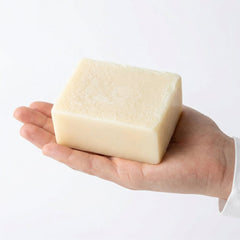

Most modern “washes” are detergents in liquid form. They clean by stripping. There's an older, gentler way that still works.
“Why does my skin feel tight 10 minutes after I shower?”
Because what you're washing with is not soap. It's a detergent — a synthetic surfactant designed to lift oil off industrial surfaces, repackaged in a bottle with fragrance and a moisturising claim.
It cleans. It also strips. And the tightness, the flaking, the eczema patches that flare in winter — those are all the skin barrier saying it's been stripped of fats it needs to function.
The quiet swap the industry made
If you read the back of a Dove Beauty Bar, a Cetaphil Bar, or any liquid body wash, you'll see ingredients like sodium lauryl sulphate, sodium laureth sulphate, cocamidopropyl betaine, or sodium cocoyl isethionate. These are syndets — short for synthetic detergents.
They lather a lot. They feel “squeaky clean”. And they are not, technically or legally, soap. In many countries syndet bars can't even use the word “soap” on the front. That's why Dove calls it a “Beauty Bar”. It's a labelling rule.
Real soap is something different: a fat (animal or plant) reacted with an alkali (lye) in a process called saponification. The lye fully reacts away. What's left is a mild surfactant that cleans without dissolving your skin's lipid layer in the process.
For most of human history, that was the only thing people washed with.
Why the swap happened (and why it's not in your interest)
Syndets are cheaper to mass-produce, more stable on a warehouse shelf in any climate, and easier to pump into a bottle. They also lather aggressively, and the industry trained us to believe lather equals cleanliness.
None of that is about your skin. It's about the supply chain.
The trade-off you pay shows up as:
- Tight, “squeaky” skin after washing
- Flaking on shins, forearms, and the sides of the neck
- A barrier that needs three products to repair what one wash damaged
- Long-term, a skin that no longer regulates its own oil — so it overproduces, and you're told you have “oily skin” and sold something else
The over-cleansing tax
Most people in the UAE shower once or twice a day in hard, chlorinated water, with a syndet body wash, then towel off in air-conditioned air. That's three drying forces in five minutes.
Then they apply a body lotion to put back what the wash just took. The lotion is 70% water held together with emulsifiers, so it evaporates by lunchtime, and they top up again. Two products, twice a day, to undo each other.
The cleanest way out of that cycle is to stop the stripping at the source.
What real soap does differently
A cold-process tallow soap cleans by lifting dirt and excess oil — not by dissolving the skin's lipid layer underneath. Tallow's fatty-acid profile (stearic, oleic, palmitic) is the closest natural match to human sebum, so even the small amount that stays on the skin after rinsing is a fat your skin recognises.
You won't get the aggressive foam. Real soap is low-lather — that's a feature, not a defect. The lather you're used to is mostly added foaming agents doing theatre.
What you'll get instead: skin that feels clean without feeling tight. A barrier that isn't fighting you all day. Less need for the lotion, the serum, and the barrier cream you're currently stacking.
“But isn't it drying? Soap is harsh, right?”
That's the reputation of cheap industrial soap — the kind made with low-quality fats, no curing time, and excess lye. A properly made cold-process bar is something else.
INSHA's Simple Tallow Soap is saponified from halal-guaranteed grass-fed beef tallow, coconut oil, and (in the Simple Olive variant) cold-pressed olive oil. Cured for 4–6 weeks so the bar is hard, mild, and long-lasting. No lye remains. No synthetic fragrance. No SLS. No preservatives — because there's nothing in a cured bar that needs preserving.
Real soap is low-lather. The aggressive foam you're used to is theatre, paid for in barrier damage.
A simpler shower shelf
You don't need a body wash, a face wash, a hand soap, and a shaving cream. One 100g bar — properly stored on a dry dish between uses — handles all four, lasts 4–8 weeks for most people, and costs less per wash than any of them.
If the tight-skin cycle is something you're tired of, the swap is straightforward.
Try Simple Tallow Soap — The OG, 28 AED →
FAQ
Is body wash actually soap?
Almost never. Most body washes and “beauty bars” (Dove, Lux, Olay, Cetaphil) are syndets — synthetic detergents — not soap. In many jurisdictions they legally cannot be called soap on the label. Real soap is fat saponified with lye; everything else is a detergent in a bottle.
Why does my skin feel tight after I shower?
Because the detergents in your body wash strip the skin's lipid layer along with the dirt. Tightness, flaking, and the urge to immediately moisturise are signs your barrier has just been over-cleansed.
Is low-lather soap a sign it isn't working?
No. Real cold-process soap produces a creamy, modest lather rather than thick foam. The aggressive foam in commercial washes comes from added foaming agents, not from cleaning power. Low lather is normal and expected.
Is tallow soap actually mild enough for daily use?
Yes. A properly cured cold-process tallow bar is among the mildest cleansers available because tallow's fatty-acid profile matches human sebum. The skin recognises what's left on it after rinsing rather than reacting to it as a foreign surfactant.
Is INSHA Simple Tallow Soap halal?
Yes. Every bar is made with halal-guaranteed grass-fed beef tallow, sourced and documented from slaughter through to the finished bar.
Will switching to a tallow soap break me out?
For most people, no — and many find acne and barrier issues improve once they stop stripping. If you have active cystic acne and are already using prescription actives, introduce the bar slowly and watch your skin for two weeks before committing.
Keep reading: How to use a tallow soap bar — face, body, shaving · Tallow soap vs Dove, Aleppo, Castile, African Black · Simple Tallow Soap product page