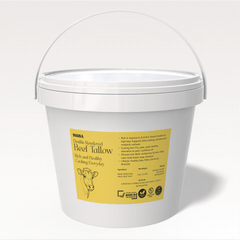

Seed oils are out. Coconut oil left half your shelf greasy. Vaseline isn't food. A single rendered fat solves both problems.
The search that keeps ending in the same dead-end
You opened a tab to find a cooking oil that isn't a seed oil. You opened another tab to find a single-ingredient skin balm without fragrance, emulsifiers, or a 20-line INCI list. After an hour you closed both — because every option fails on the same thing: it's processed, it's a blend, or it's only really suitable for one of the two jobs.
This is the gap most modern pantries and bathroom shelves share. A clean, traceable, heat-stable fat that you can actually cook with, and that's pure enough to put on your face if you choose to. It used to be a normal thing to have in the kitchen. Then industrial seed oils took the cooking job and petroleum-derived products took the skin job, and the single-ingredient fat in the middle quietly disappeared.
Why seed oils stopped being acceptable
Sunflower, canola, soybean, corn, and rapeseed oils are the default in most UAE supermarket cooking and almost every restaurant fryer. They have three problems most cooks don't think about:
1. They aren't stable at high heat. Their fatty-acid structure breaks down when fried or roasted, producing oxidation byproducts that didn't exist before the pan got hot.
2. They are heavy in omega-6. Modern diets already supply far more omega-6 than the body uses well. The ratio matters more than the raw amount, and seed oils tilt the ratio the wrong way.
3. They are industrial outputs, not foods. Most are extracted with solvents, deodorised, and bleached before they reach the bottle. The smell test for “clean cooking oil” stops being a useful guide once you read the process.
None of this makes one meal a problem. It makes the default fat in every meal a problem.
Why coconut oil and ghee didn't fully solve it either
The seed-oil refugee usually lands on coconut oil first. It's stable at heat, it's traceable, it's one ingredient. The two things it isn't: neutral in flavour, and similar to the fats your own body makes. Half your savoury food tastes like a dessert, and on skin it sits heavy and clogs pores for some people.
Ghee is the local default, and there is nothing wrong with ghee — INSHA isn't going to argue with anyone's grandmother. It's a step up from seed oils for cooking. But ghee is a dairy product, which means lactose-sensitive households cross it off, and most supermarket ghee in the UAE comes from cattle whose feed and slaughter chain aren't documented in any way you can verify.
Butter has the same dairy issue and a lower smoke point. Lard is the closest cousin to tallow but in this region the halal-traceable version is hard to find and the religious objections are obvious.
Why “just use Vaseline” stops working for skin
The DIY-skincare side of the search has its own dead-end. Vaseline is the default barrier-balm recommendation because it's cheap and it works on the narrow job of “stop water leaving the skin overnight”. But it's a petroleum byproduct, it doesn't feed the skin anything, and it sits on top permanently — which is fine on cracked heels and uncomfortable on a face.
The clean-skincare alternative is usually a 15-ingredient cream from a brand promising “barrier repair”, which is back to the exact problem you opened the tab to escape.
What you were actually looking for
One fat. Stable on the hob. Mild enough in flavour that it doesn't take over a dish. Pure enough in form that it can sit on your skin overnight without an ingredient list. Sourced from animals raised and slaughtered in a way you can verify.
This is what rendered beef tallow has always been — and specifically what double-rendered halal beef tallow is. Rendered means the suet (the fat around the kidneys, the cleanest fat the animal makes) is slowly melted, the solids strained out, and the pure fat poured. Double-rendered means that step is done twice. The result has a long shelf life, a near-neutral smell, and a structure stable enough for high-heat cooking and gentle enough for skin.
The “wait, the same jar for both?” question
Yes — and it's the boring answer, not a marketing flourish.
The same fat that fries an egg cleanly is the same fat that sits closest to the lipids in human skin. There is no version of this product that's “the cooking one” and “the skincare one”; the rendering process that makes it pure enough for one makes it pure enough for the other. Most households who buy a tub end up using it for both within a month — typically the bulk for cooking and a small jar transferred to the bathroom for skin, hands, lips, and cuticles.
If you want a fully formulated, whipped, scented skin balm with olive oil and manuka honey added, that's the Tallow Glow Balm — same base fat, ready to use. The tub you're reading about is the raw material: cooking-grade and skin-grade in the same form.
Where this stops being the right answer
Honest list, short:
- If you want a flavour-neutral oil for a vinaigrette, use a cold-pressed olive oil — tallow is solid at room temperature.
- If you specifically want the dairy notes of ghee in your biryani, use ghee.
- If you want a finished face cream that you don't have to think about, the Tallow Glow Balm is the easier choice.
- If you object to animal products on principle, none of INSHA's range is built for you — this is a halal-traceable animal-sourcing brand.
One rendered fat. Two shelves. No emulsifiers, no fragrance, no ingredient list.
What to do next
If this is the single-fat answer you've been looking for, the 1 Kg tub at 72 AED is the trial size — it's enough cooking fat for roughly a month of a small household, with plenty left to decant a small jar for the bathroom. The larger packs (2 Kg, 3 Kg, 5 Kg, 10 Kg) drop the per-kilo cost for households that already know they want it as their daily kitchen fat.
FAQ
Is beef tallow actually safe to cook with at high heat?
Yes. Beef tallow is roughly 50% saturated fat, which is what makes it stable when fried, roasted, or seared. It does not break down into oxidation byproducts the way seed oils do at the same temperatures.
Why double-rendered instead of single-rendered?
Double-rendered means the fat is strained twice during the rendering process. The second pass removes residual solids and trace impurities, which gives a longer shelf life, a near-neutral smell, and a clean enough form to use on skin as well as in cooking.
Will my food taste beefy?
No. Properly double-rendered tallow has a mild, almost neutral flavour — closer to a clean roasting fat than to beef itself. It enhances savoury food without overpowering it, which is the difference between it and coconut oil.
Can I really use the same tub for cooking and for my skin?
Yes — and most customers do. The rendering process that makes it pure enough for cooking makes it pure enough for skin. Most households decant a small portion into a clean jar for the bathroom and keep the rest in the kitchen.
Is INSHA's beef tallow halal-certified?
Yes. Every batch is rendered from halal-slaughtered, grass-fed cattle with traceable sourcing documented per batch. The full chain of custody is auditable on request.
How is this different from the Tallow Glow Balm?
This is the raw, unscented, single-ingredient rendered fat in a jar — for cooking or DIY skincare use. Tallow Glow is the same base fat whipped with cold-pressed olive oil, manuka honey, beeswax, and an optional scent to make a ready-to-use face and body balm.
Keep reading: How to use beef tallow — cooking + DIY skincare · Tallow vs ghee, coconut oil, butter, lard · Double-Rendered Beef Tallow product page