
Body skin is thicker, drier, and far more neglected than face skin. The thin lotions you've been using were never built for it.
Meet the body version of tallow →
The two-week pattern almost everyone runs
You buy a body lotion. It smells nice. The first few mornings after the shower it feels good. By day ten, your shins are tight again. By day fourteen, you've quietly given up and the bottle moves to the back of the shelf.
Next month you try a different one. Same arc. Same result.
This is not a discipline problem. It's a formulation problem. Most body lotions are mostly water held together with cheap emulsifiers, and your body skin needs something the bottle isn't giving it.
Body skin is not face skin
The skin on your shins, elbows, knees, and the backs of your arms is structurally different from your face. It is thicker. It has fewer oil glands. It gets washed with hotter water, scrubbed harder, exposed to dry air-conditioning, and almost never treated with anything more substantial than whatever lotion was on sale.
The face gets serums, oils, sunscreens, masks. The body gets a squirt of supermarket lotion if you remember.
It's no wonder the body looks neglected. It is neglected.
Why cheap body lotion fails on shins
Walk into a pharmacy and pick up any mainstream body lotion. Turn the bottle around. The first ingredient — usually 70 to 85 percent of the formula — is water. The next handful are emulsifiers, glycerin, a synthetic fragrance, a preservative system, and a small amount of plant oil or butter near the bottom of the list.
That formula has one job: feel light enough that you'll actually use it. It is not built to refill anything. The water evaporates within minutes. The thin film left behind washes off the first time you put on jeans.
For a forearm in a humid climate, that's fine. For a shin in air-conditioning, after a hot shower, in winter, on a body that's already low on natural lipids — it does nothing measurable.
The “alligator skin” effect
You know the look. Faint diamond-shaped cracks on the shins. White flakes when you scratch. A dullness that doesn't catch the light. Sometimes called “alligator skin”, sometimes called xerosis, often just called “my legs in winter”.
It happens because the outer layer of skin has lost the fats that hold its cells together. Water escapes faster than your body can replace it. The cells curl up at the edges. Light hits them and scatters instead of reflecting.
A water-based lotion sits on top of this for an hour, then leaves. It is not refilling anything.
KP — the bumps on the back of your arms
Keratosis pilaris is the small rough bumps you can feel on the backs of your upper arms, sometimes the thighs. It's a build-up of keratin around hair follicles. It's harmless. It also doesn't go away with a thin lotion.
KP responds to two things: gentle exfoliation, and a heavy, lipid-rich balm applied to damp skin. The lotion you've been trying does neither.
“I shower then I'm dry again in an hour”
This is the most common complaint we hear about body skin in the UAE. You step out of a hot shower, towel off, slap on lotion, get dressed. By the time you've sat in air-conditioning for an hour, your shins itch.
The hot water stripped the natural oils. The towel removed what was left. The lotion put back a little water, which evaporated. You're now drier than before you washed.
The fix is not a thicker lotion. The fix is a different category of product entirely — one with enough fat in it to actually replace what the shower took away.
What body skin is actually asking for
A balm, not a lotion. Something built almost entirely from fats your body recognises, applied to damp skin straight out of the shower, in an amount that feels almost too generous.
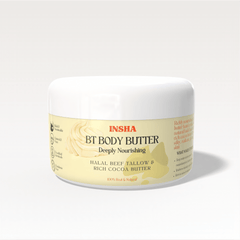
This is the case for a tallow-based body butter. Rendered fat from grass-fed cattle has a fatty-acid profile close to your own skin's lipids. Blended with cocoa butter for structure and jojoba oil for slip, it gives the body what a 200ml bottle of water-and-emulsifiers cannot — actual refilling material.
A body balm is not a thicker lotion. It is a different category of product, built around fat instead of water.
“But will it feel heavy?”
Properly whipped tallow body butter is solid in the jar and melts on contact with skin. Used on damp skin, it absorbs in under a minute. There is no greasy film by the time you put on clothes. The trick is damp skin and a small amount per limb — not slathering it on dry.
A simpler shelf
You don't need a separate hand cream, foot cream, elbow cream, stretch-mark oil, and KP scrub. One body balm, applied properly after the shower, handles most of what those bottles claim to do.
If the daily lotion routine isn't working, the answer probably isn't a new lotion. It's a different kind of product.
Try BT Body Butter — 200 ML, 107 AED →
FAQ
Why are my shins always dry even though I moisturise?
Most body lotions are 70 to 85 percent water held together with emulsifiers. The water evaporates within minutes and the thin oil film left behind washes off your clothes. Shins have fewer oil glands than the rest of your body, so they need a balm with real fat content, not a lotion.
What is the difference between a body lotion and a body butter?
A lotion is mostly water with a small amount of oil emulsified into it. A body butter is mostly fat with very little or no water. Lotions feel light but do not refill the lipids your skin barrier is built from. Body butters do.
Does body butter help with KP (keratosis pilaris)?
KP responds to two things — gentle exfoliation and a lipid-rich balm applied to damp skin. A water-based lotion does not provide enough fat to soften the keratin plugs. A tallow-based body butter, used daily on damp skin after the shower, is the routine most people find works.
Why does my skin feel drier in air-conditioning?
Air-conditioning pulls humidity out of the air. Your skin loses water to the dry environment faster than your barrier can hold it in. If the barrier is already short on fats — which is the default for most body skin — the dryness is immediate and constant. The fix is a balm dense enough to slow that water loss.
Is body butter only for winter?
No. In the UAE, the year-round combination of hot showers, harsh sunlight, and constant air-conditioning means body skin loses fats every single day. A body butter is a year-round product. Lighter amounts in summer, more in winter.
Can I use my face balm on my body instead?
Yes, but it gets expensive fast. Body skin needs a much larger amount per application — a 50ml face balm would last a few days. A dedicated body butter in a larger jar, formulated with cocoa butter for body-skin needs, is the practical answer.
Keep reading: How to use a body butter properly · Body butter vs The Body Shop, Nivea, Palmer's, Bio-Oil · BT Body Butter product page