
Five minutes of reading. One tool instead of seven. A routine you can run tonight.
Start with the stainless tool — Dhs. 36 →
What's in the box — and why the heart-shape edge matters
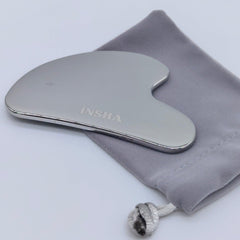
INSHA's gua sha is a single piece of surgical-grade 316L stainless steel, cut into a heart shape. The shape is not decoration. Each contour has a job:
The long flat side — cheek sweeps, neck strokes, and the underside of the jaw.
The deep V at the top — hooks the jawbone and rides along it for definition work.
The pointed corner — brow bone, around the nose, and the small muscle in front of the ear that holds a surprising amount of tension.
The smooth curve at the bottom — under-eye area, where the skin is too delicate for an edge.
Prep — the part most people skip
Two things matter before the stone touches your face. One: the stone must be cold. Keep it in the fridge. Cold constricts vessels and doubles the de-puffing effect. Two: your skin must have a glide layer. Dry steel on dry skin will drag, redden, and feel terrible.
A drop of facial oil or a pea-sized scoop of balm is enough. We use Tallow Glow because its lipid profile sits close to your own sebum, so the stone slides without the skin fighting it. Any clean facial oil works.
The pressure rule
The pressure you want is the weight of a butter knife. Enough to drag the skin and the fascia under it; not enough to leave a pink line. If you see redness after a stroke, halve the pressure. The work is in the slowness, not the force.
The eight-stroke face map
Every stroke moves outwards from the centre and downwards towards the collarbones. That direction is the lymph map. Going the other way pushes fluid back into the face.
1. Neck (always first). Long flat side, from under the ear straight down to the collarbone. Five strokes per side. This opens the drain so everything you sweep next has somewhere to go.
2. Jaw underside. The V edge. Hook the jaw under the chin and ride it back to the ear. Five times each side.
3. Jawline top. Flat side, from chin sweeping out and up towards the ear. Five each side.
4. Cheeks. Flat side, from the nose outwards along the cheekbone, ending at the temple. Five each side.
5. Under-eye. Smooth curve only, very gentle. From the inner corner sweeping out to the temple. Three each side. No pressure.
6. Brow bone. Pointed corner, from the inner brow sliding outwards along the bone. Three each side.
7. Forehead. Flat side, sweeping up and out from between the brows towards the hairline. Five strokes, alternating sides.
8. Drain finish. Repeat the neck strokes from step 1 to flush everything down. Five each side.
Total time: about five minutes. Total fluid moved: visible the moment you look up.
The work is in the slowness, the cold, and the direction. Speed is the enemy of every gua sha.
Frequency
Daily for de-puffing is fine. For deeper sculpting and tension release, three to four sessions a week with a full rest day in between is more effective than seven rushed sessions. The fascia adapts; let it.
Care
Rinse with warm water and a drop of soap after every use. Dry immediately with a clean towel — do not air-dry on a wet counter. Once a week, wipe with rubbing alcohol or hold under boiling water for thirty seconds. Store in a dry drawer or back in the fridge if you like the morning cold.
When not to use it
Skip the session if your skin has any of the following: active acne lesions you would scrape over, sunburn, eczema flare, recent dermatological treatment in the last 48 hours, dermal fillers in the last two weeks, or open broken skin. Work around them, not over them.
The other places this tool works
The same stone is excellent on the neck and shoulders for tension headaches — strokes from the base of the skull down towards the shoulder, in the same butter-knife pressure. Also good on the back of tired hands.
Get the stainless gua sha — Dhs. 36 →
FAQ
How often should I use it?
Daily for de-puffing. Three to four times a week for deeper sculpting. Rest days are part of the protocol — the fascia needs them.
Wet or dry?
Always with a glide layer. Oil or balm. Never dry steel on dry skin.
What product should I pair it with?
Any clean facial oil or balm. Tallow Glow is our recommendation because the lipid profile lets the stone glide without skin friction.
Can I share my tool?
It is hygienic enough to share if both people sanitise between uses. We still recommend one tool per person.
How long until I see results?
De-puffing is visible the first session. Jaw definition shows after two to three weeks of consistent use. The sharper changes — fascia release, softer tension lines — take eight to twelve weeks.
Morning or night?
Morning if you want the de-puff. Night if you want the relaxation. Both is fine; pick one and be consistent before adding the other.
Will it hurt?
Not at butter-knife pressure. If it hurts, you are pressing too hard or the skin has no glide layer.
Keep reading: Why your face puffs up by 4pm · Stainless vs jade vs rollers — honest comparison · Gua Sha product page