
Most modern creams sit on top of your skin. Your skin barrier needs something closer to itself — a fat it recognises.
The "great moisturiser" that suddenly does nothing
You buy a new cream. The first week it feels incredible. By week three your skin is dry again — sometimes drier than before. You add a second product. Then a serum. Then an oil on top. The bathroom shelf fills up and your skin still tightens an hour after washing.
This is not a willpower problem and it isn't your skin getting "used to it". It's a barrier problem. And the products you're piling on are, in many cases, the reason the barrier never gets to heal.
What "barrier" actually means — without the chemistry lecture
Your skin's outer layer is a wall of cells held together by fats — the same kind of fats your body already makes. When that wall is intact, water stays in and irritants stay out. When the fats run low, water escapes faster than you can replace it. That's the tight, flaky, "I just moisturised and I'm dry again" feeling.
Most modern moisturisers don't refill those fats. They sit on top, they trap a bit of water for a few hours, and they wash away. That's why you keep needing more.
The three quiet reasons modern moisturisers underperform
1. They're built around water, not fat. A typical cream is 60–80% water held together with emulsifiers. Water evaporates. Your skin needs the fat that gets left behind — and there often isn't enough of it.
2. The fats they do contain don't match your skin. Plant butters and mineral oils are fine for short-term softening. But they're not the same lipids your sebaceous glands produce. Your skin treats them as guests, not as part of itself.
3. They include things that strip the barrier they're meant to protect. Fragrance, sulphates, harsh preservatives, "brightening" acids — every one of these gives a short-term result and takes a small bite out of the wall. Over months, that adds up.
What your skin is actually asking for
A fat it recognises. Something with a profile close to your own sebum, in a form simple enough that nothing in it is fighting your barrier.
This is the case for beef tallow — the rendered fat of grass-fed cattle. Its fatty-acid profile is closer to human sebum than almost anything else you can apply. Your skin doesn't have to translate it. It absorbs.
Beef tallow's fatty-acid profile is the closest natural match to human sebum. That's why ancestral skincare keeps coming back to it.
"But isn't that…heavy?"
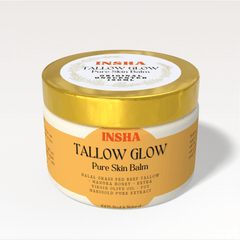
Properly rendered tallow is not the greasy block you're picturing. INSHA's Tallow Glow Balm is double-strained, whipped, and blended with cold-pressed olive oil and manuka honey so a pea-sized amount melts into the skin in seconds. No film, no shine, no residue on a pillowcase.
A simpler shelf
You don't need seven steps. You need one product that refills what your skin is missing, applied to slightly damp skin, twice a day. Most people see the tightness ease inside a week and the flaking stop inside three.
If that's the experiment you want to run on your own face, here's where to start.
Try Tallow Glow — 50 ML, 58 AED →
FAQ
Why does my moisturiser stop working after a few weeks?
Most moisturisers are water-heavy and sit on top of the skin without refilling the fats your barrier needs. Once the water evaporates, the dryness returns — sometimes worse, because the formula includes ingredients that quietly weaken the barrier over time.
Is beef tallow really better than a normal cream?
It's not better at everything — it's better at one specific thing: refilling the lipids your skin barrier is built from. Beef tallow's fatty-acid profile is the closest natural match to human sebum, which is why it absorbs without needing to be translated.
Will tallow feel greasy on my face?
Properly rendered, whipped tallow doesn't. INSHA Tallow Glow is double-strained and blended with olive oil and manuka honey so a small amount melts on contact. No film, no shine.
Is INSHA tallow halal?
Yes. Every batch is rendered from halal-slaughtered, grass-fed cattle. The full sourcing is documented on each batch.
How long until I see a difference?
Most people notice tightness ease within a week and visible flaking stop within three. Deeper barrier repair usually takes 4–6 weeks of consistent twice-daily use.
Keep reading: How to use the balm — face, body, baby · Tallow vs CeraVe, shea, Vaseline — honest comparison · Tallow Glow product page