
Smoke point, ratios, what it replaces, how to whip it for the bathroom, and how to store it through a UAE summer.
Start with the 1 Kg tub (72 AED) →
What's in this tub — and what isn't
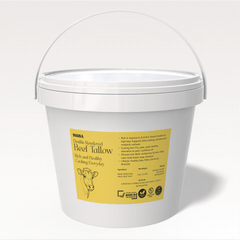
INSHA Double Rendered Halal Beef Tallow is one ingredient: halal-slaughtered, grass-fed beef suet, slowly rendered down and strained twice. That's the whole list. No preservatives, no antioxidants, no flavouring, no carrier oils.
It arrives solid and creamy-white, with a faint clean smell. Warmed in the hand it turns to liquid in about thirty seconds. That dual state — solid at room temperature, liquid at body or pan heat — is what makes it work for both cooking and skincare without any reformulation.
Kitchen use: what it replaces, and the smoke point that matters
Tallow's smoke point sits around 200–250°C depending on purity, which puts it comfortably above olive oil and above any seed oil you'd be tempted to deep-fry in.
Use it in place of:
- Sunflower, canola, soybean, corn, rapeseed oil — directly, 1:1, anywhere they appear.
- Vegetable shortening (Crisco) — directly, 1:1 by weight, in pastry and frying.
- Ghee — 1:1 for sautéing, frying, roasting. Slight flavour difference; tallow is cleaner, ghee is nuttier.
- Butter for frying — 1:1, but expect a higher smoke point and slightly less browning.
- Olive oil for high-heat cooking only — keep your cold-pressed olive oil for dressings and finishing.
Where it shines:
- Frying eggs (the yolk holds, the white crisps at the edge).
- Searing steaks and chops — adds a clean roast flavour.
- Roasting potatoes, root vegetables, cauliflower.
- Popping popcorn — a small spoon in the pot, then salt.
- Pastry crusts — flakier than butter, cleaner than shortening.
- Seasoning cast iron and carbon steel pans.
Where it isn't the right tool:
- Salad dressings — it's solid at room temperature.
- Recipes that depend on the dairy notes of butter (béchamel, beurre blanc).
- Sweet baking where you want a butter-forward flavour.
Skin use: the simplest possible barrier balm
The honest version first: you don't need to do anything to the tallow to use it on skin. Scoop a rice-grain amount, warm between fingertips for two seconds, press into slightly damp skin. That's the entire method.
Most people, though, want a slightly softer texture that spreads more easily and doesn't sit as heavy. The classic ratio is two parts tallow, one part cold-pressed olive oil, gently melted together and let to set in a clean jar. That's a homemade barrier balm in roughly five minutes, with two ingredients and zero preservatives.
If you want to add scent, the safe rule is no more than 1% essential oil by weight of the finished blend — anything more is asking for sensitisation. Frankincense, lavender, and citrus oils are common choices; avoid hot oils like cinnamon and clove on facial skin entirely.
If you want the whipped, scented, ready-made version with honey and beeswax built in, that's the Tallow Glow Balm. The tub is for people who'd rather buy the raw material and finish it themselves.
The decant-and-split routine most households use
Buy the 1 Kg tub once. On day one, decant roughly 50–80 g into a small clean glass jar, label it for the bathroom, store the rest in the kitchen. Use the kitchen tub for cooking; use the bathroom jar for hands, lips, cuticles, dry patches, scars once closed, and a thin layer on the face overnight if you're testing facial use.
The bathroom jar typically lasts two to three months. The kitchen tub depends entirely on how much you cook — for a small household replacing all their cooking oil with tallow, a 1 Kg tub lasts roughly four to six weeks.
The size guide
| Size | Best for | Roughly lasts (cooking + a small bathroom decant) |
|---|---|---|
| 1 Kg — 72 AED | First-time buyers, trial size | 4–6 weeks for a small household |
| 2 Kg — 116 AED | Households fully switched off seed oils | 8–10 weeks |
| 3 Kg — 165 AED | Larger families or frequent home fryers | 10–14 weeks |
| 5 Kg — 260 AED | Best per-kilo value for regular cooks | 4–5 months |
| 10 Kg — 485 AED | Bulk for households, small restaurants, food entrepreneurs | 8–10 months |
If you're new to tallow, the 1 Kg is the obvious trial. If you already know you want it as your default kitchen fat, the 5 Kg drops the per-kilo cost meaningfully.
Storage — the part the UAE summer makes important
Tallow is shelf-stable; it doesn't need refrigeration. Stored in a cool, dry place away from direct sunlight, an unopened jar comfortably keeps for 12 months and an opened jar for 4–6 months.
UAE-specific notes:
- Don't store it on a windowsill or anywhere it gets afternoon sun — it will liquefy and re-set repeatedly, which is fine for the fat but cosmetically alarming.
- A kitchen cupboard away from the hob is the right spot.
- The bathroom jar is fine in a drawer; it doesn't need to be in the fridge.
- If you keep a tub for more than a year, smell it before use. Pure tallow either smells clean or — if it's gone — smells obviously off. There is no ambiguous middle.
Scent: what to expect
A fresh jar of double-rendered tallow smells faintly clean, slightly waxy, almost neutral. If you've smelled badly-rendered tallow before (the kind that smells like a steakhouse kitchen), this isn't that. The second rendering is the step that removes most of the residual beef notes.
When you cook with it, food doesn't pick up a beef flavour the way it does with bacon fat. Eggs taste like eggs cooked well. Roast potatoes taste like better roast potatoes.
The first-week routine to try
- Day 1: Replace your usual cooking oil for one meal. Fry eggs in it.
- Day 2: Sear a piece of chicken or beef in it. Notice the colour you get on the pan.
- Day 3: Decant 50 g into a clean jar for the bathroom.
- Day 4: Try a rice-grain amount on dry hands or lips before bed.
- Day 5: Roast a tray of vegetables in a tablespoon of it.
- Day 7: Decide if it's earning its shelf space. Most people are buying the larger pack within a month.
One rendered fat. Two shelves. No emulsifiers, no fragrance, no ingredient list.
Ready to start?
The 1 Kg tub at 72 AED is the right place to begin. If you're already a confident cook who wants to switch your whole kitchen off seed oils, jump to the 5 Kg.
FAQ
What's the smoke point of beef tallow?
Roughly 200–250°C depending on rendering purity, which is higher than olive oil and comfortably high enough for frying, searing, and roasting. Double-rendered tallow tends to sit at the upper end of that range.
Can I deep-fry in beef tallow?
Yes. It's one of the most stable fats for deep frying because of its saturated-fat content and high smoke point. Restaurants used to fry exclusively in tallow before vegetable shortening replaced it in the 1980s.
How do I make a simple skin balm from this tub?
Gently melt two parts tallow with one part cold-pressed olive oil over the lowest heat, pour into a clean glass jar, let it set at room temperature. Optional: add up to 1% essential oil by weight before pouring. Apply a rice-grain amount to damp skin.
Does it need to be refrigerated?
No. Stored in a cool, dry place out of direct sunlight, an opened jar keeps for 4–6 months and an unopened jar for around 12 months. In a UAE kitchen, a cupboard away from the hob is fine.
Will my house smell of beef when I cook with it?
No. Double-rendered tallow has a near-neutral smell when cooked. Whatever you're cooking — eggs, potatoes, chicken — smells like that food cooked well. It does not impart a beef flavour to your meal.
How much do I use to replace another cooking fat?
1:1 by weight or volume against seed oils, butter, ghee, or vegetable shortening. A tablespoon of canola oil becomes a tablespoon of tallow — no conversion needed.
Keep reading: Why one rendered fat solves the kitchen and skin shelf · Tallow vs ghee, coconut oil, butter, lard · Double-Rendered Beef Tallow product page