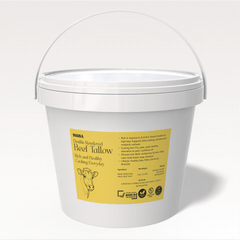

Where the raw tub wins. Where ghee is still the right choice. And which INSHA product to pick if you only want one.
The short version
If you want one fat that handles high-heat cooking, replaces seed oils, and can double as a DIY skincare base, the raw double-rendered tallow tub is almost always the right pick. If you want a ready-made face and body balm and you'll never use the kitchen side, the Tallow Glow Balm is the simpler product. We'll lay out where each option earns its place.
The cooking-fat comparison
| INSHA Double-Rendered Tallow | Ghee | Coconut oil | Butter | Lard (pork) | Sunflower / canola | |
|---|---|---|---|---|---|---|
| Smoke point | ~200–250°C | ~250°C | ~177–232°C | ~150°C | ~190°C | ~225°C |
| Stable at high heat | Yes | Yes | Yes | No | Yes | No (oxidises) |
| Dairy-free | Yes | No | Yes | No | Yes | Yes |
| Halal-traceable batch | Yes | Brand-dependent | Yes | Brand-dependent | No | Yes |
| Single ingredient | Yes | Yes | Yes | Yes | Yes | Often refined |
| Neutral flavour | Yes | No (nutty) | No (coconut) | No (dairy) | No (porky) | Yes |
| Usable on skin | Yes | Limited | Yes | No | Yes | No |
| Roughly cost per kg | 72 AED | ~35–55 AED | ~35–70 AED | ~40–60 AED | N/A halal | ~10–25 AED |
Tallow vs ghee
Ghee is the regional default and it deserves the respect. It's stable, it's traditional, and in most Emirati and South Asian households it's been the cooking fat for generations. We're not going to argue with that.
Where tallow gets the edge:
- Dairy-free. Lactose-sensitive households can use tallow daily; ghee removes most of the milk solids but trace dairy proteins can remain.
- Halal-traceable per batch. Most supermarket ghee in the UAE is mass-imported and the source-animal chain isn't documented in any way you can verify.
- Doubles for skin. Ghee is technically usable on skin but the dairy notes linger and the texture isn't ideal.
Where ghee wins:
- Specific dishes. Biryani, halwa, sweets that depend on the nutty caramelised-milk flavour of ghee — tallow doesn't replicate that note.
- Wider availability at small grocery prices.
Verdict: keep ghee for the dishes that need it. Use tallow as the everyday frying, roasting, and searing fat.
Tallow vs coconut oil
Coconut oil was the first wave of escape from seed oils, and it's a perfectly stable cooking fat. The problem most people run into after a year is that everything they cook has a faint coconut note — fine for curries and stir-fries, distracting in eggs and roast vegetables.
Where tallow gets the edge:
- Neutral flavour. Eggs taste like eggs, not coconut macaroons.
- Closer match to human sebum for skin use — coconut oil sits heavier and clogs pores for a noticeable percentage of users.
- Higher smoke point than virgin coconut oil.
Where coconut oil wins:
- Vegan-friendly if that's a non-negotiable.
- Cheaper at supermarket scale.
- Better in tropical baking where you actively want the coconut flavour.
Verdict: if the coconut flavour bothers you or the skin-pore issue applies to you, tallow is the upgrade.
Tallow vs butter
Butter is delicious. It's also 16% water and burns around 150°C, which is why every chef who knows what they're doing uses clarified butter (ghee) or another fat for high-heat work.
Tallow replaces butter for cooking heat applications — frying, searing, roasting. It does not replace butter for flavour applications — spreading on bread, finishing pasta, making sauces.
Verdict: different jobs. Keep both.
Tallow vs lard
Lard is the porcine cousin. In Western cuisines historically it was interchangeable with tallow for cooking and skincare. In the UAE the obvious religious objection rules it out for most households, and the halal-traceable pork market doesn't really exist.
Verdict: not a real option in this region. Tallow is the equivalent.
Tallow vs Crisco / vegetable shortening
Crisco is hydrogenated soybean and palm oil. It exists because beef tallow used to be the standard frying and pastry fat until industrial seed-oil interests displaced it in the 1980s. Crisco does the job at a low price; it also delivers everything we said about seed oils on the why page.
Verdict: tallow is the original, Crisco is the industrial replacement. If you object to seed oils, you also object to Crisco.
Tallow vs Vaseline (for skin)
Pure rendered tallow is a lipid feed — it refills the skin's own fats and slows water loss. Vaseline is an occlusive seal — it traps water but feeds the skin nothing, and it's a petroleum byproduct.
For cracked lips or a deep crack on a heel overnight, Vaseline is a fine occlusive. For everything else — face, hands, body, cuticles — tallow does more.
Verdict: tallow for daily skin use, Vaseline kept for the narrow heel-and-overnight-lips job if you must.
Tallow vs CeraVe / clinical moisturisers (for skin)
Clinical moisturisers use synthetic ceramides and humectants to imitate what's missing from a damaged skin barrier. They're predictable, allergen-tested, and dermatologist-recommendable.
The trade: 15–25 ingredients, fragrance and preservative debates, and a formula that often needs reapplying through the day.
Tallow's bet is simpler: give the skin the actual lipid, not a synthetic stand-in. For non-clinical dry-skin cases that's usually enough.
Verdict: under dermatologist care, follow your dermatologist. Otherwise tallow is the lower-ingredient answer to the same problem.
Within INSHA: the raw tub vs the finished balm
This is the choice most readers actually need help with.
| Double-Rendered Tallow Tub (this page) | Tallow Glow Balm | |
|---|---|---|
| What it is | Pure rendered fat, one ingredient | Whipped balm: tallow + olive oil + manuka honey + beeswax + optional scent |
| Primary use | Cooking, with skincare as a secondary use | Face and body skincare only |
| Ready to use on skin | Yes, but solid in the jar — needs warming between fingers | Yes, melts on contact, easier to spread |
| Scented | No (neutral) | Optional: Original Unscented, Citrus, Marigold, Luxe, Oud |
| Cost per gram | Lower (bulk fat) | Higher (formulated, smaller jar) |
| Right for | Cooks who want one fat for both jobs, DIY skincare makers | People who only want a ready-made face/body balm |
| Sizes | 1 Kg / 2 Kg / 3 Kg / 5 Kg / 10 Kg | 50 ML / 120 ML |
| Starting price | 72 AED | 58 AED |
The honest rule: if you cook at home most nights, buy the tub. The skincare use is a bonus and you'll spend less per gram than the balm. If you don't really cook and you just want a ready-to-use face and body balm with a scent option, buy the balm. If you want both — many households do — buy the tub for the kitchen and the balm for the bathroom.
When the raw tub is the wrong answer
Short honest list:
- You want a finished, scented face cream — get the balm.
- You don't cook at home — the tub mostly goes unused; the balm is the right product.
- You want a vegan option — INSHA isn't built for you, this whole brand is halal animal sourcing.
- You want a salad-dressing oil — tallow is solid at room temperature; use cold-pressed olive oil.
The raw tub is for households that cook and don't mind warming a small amount in their fingers for skin. The balm is for everyone who'd rather buy the finished product.
Ready to decide?
For most home cooks, the 1 Kg tub at 72 AED is the right entry. For households already off seed oils who know they want it as their default, the 5 Kg is the better per-kilo unit. For skin-only buyers, go to the balm.
FAQ
Beef tallow vs ghee — which should I cook with?
For everyday frying, roasting, and searing, tallow is the cleaner-flavoured and dairy-free option. For dishes that specifically need the nutty caramelised-milk note of ghee — biryani, traditional sweets — keep ghee. Many households use both.
Beef tallow vs coconut oil — which is better for the skin?
Tallow's fatty-acid profile is closer to human sebum, so it absorbs without sitting heavy. Coconut oil is comedogenic for a meaningful percentage of users. For face use especially, tallow is the safer default.
Should I buy the raw tub or the Tallow Glow Balm?
The tub if you cook at home and want one fat for both kitchen and skincare. The balm if you only want a ready-made face and body product. The tub is cheaper per gram of fat; the balm is formulated for spreadability and includes olive oil and manuka honey.
Is INSHA tallow more expensive than supermarket ghee?
Per kilo, yes, modestly. The reason is the inputs: halal-slaughtered grass-fed cattle with traceable per-batch sourcing, and double rendering for purity. Most supermarket ghee in the UAE is mass-imported with no comparable traceability.
Can I cook with the Tallow Glow Balm?
No. The balm contains beeswax and (in scented variants) essential oils that aren't intended for ingestion. The raw tub is the cooking product. The balm is skincare only.
Is beef tallow vegan?
No. Tallow is rendered animal fat. INSHA is built around halal-traceable animal sourcing, which is a different value choice from a plant-based brand.
Keep reading: Why one rendered fat solves the kitchen and skin shelf · How to use beef tallow — cooking + DIY skincare · Double-Rendered Beef Tallow product page